

The Geometry of the Samurai: Discovering STEAM in Japan’s Ancient History
When we think of the Japanese samurai, we often imagine epic battles or quiet moments of meditation. However, beneath the surface of the warrior’s life lies a profound mastery of precision, structural engineering, and geometric harmony. At Japan Educational Travel, we believe that the world is the ultimate laboratory. As a premier STEAM-based travel company, we don't just show students historical sites; we help them decode the mathematical and scientific innovations that allowed Japanese culture to flourish. By exploring the geometry of samurai armor and the delicate construction of kanzashi (traditional hair ornaments), we discover how the logic of shapes defines the human experience.
1. The Physics of the Blade and the Geometry of the Stance
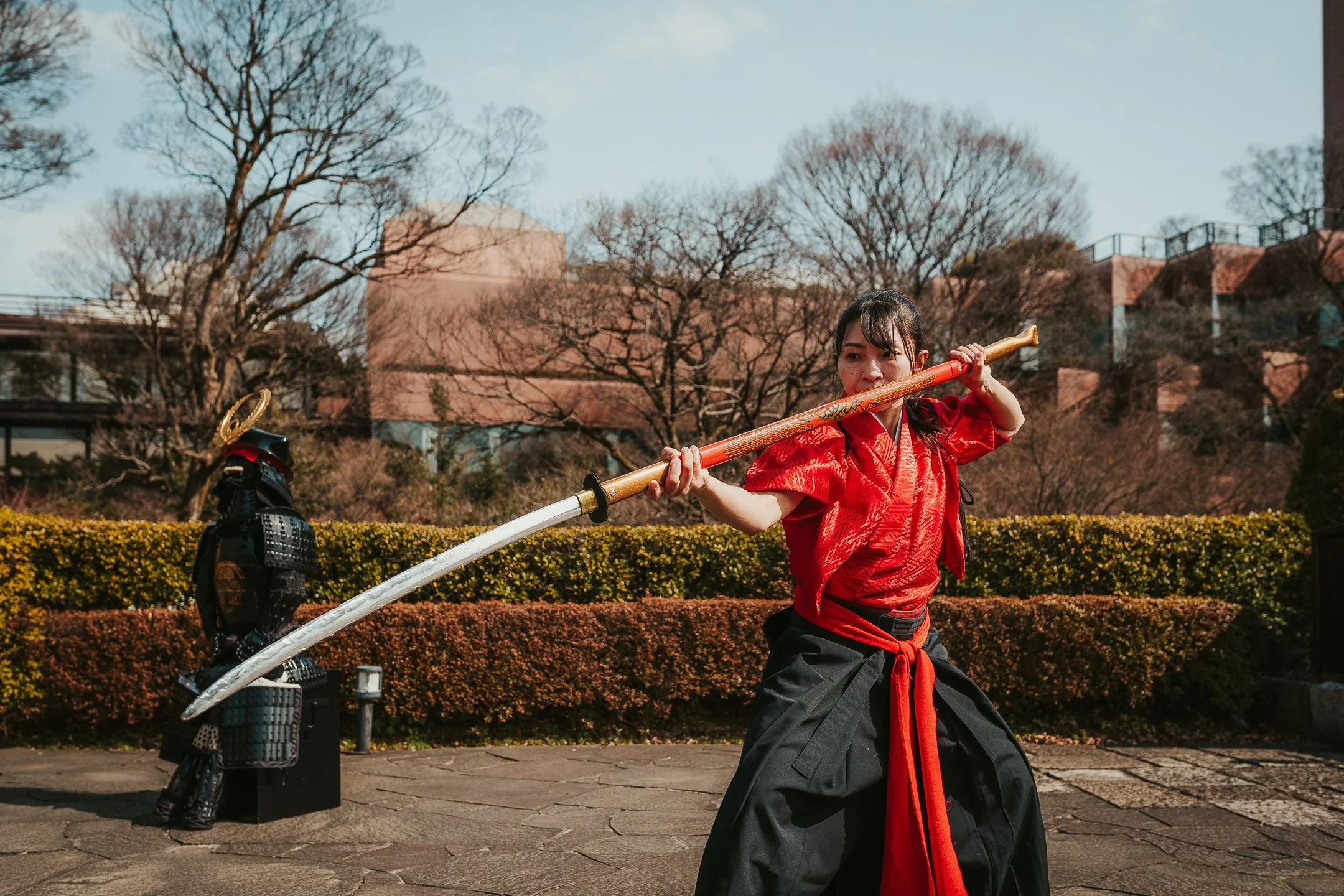
In samurai philosophy, geometry was a tool for both survival and spiritual grounding. To a samurai, a circle wasn't just a shape; it was a symbol of wholeness and the most efficient path for movement.
In our STEAM-focused workshops, students analyze the center of mass and equilateral triangles within a traditional warrior's stance. In swordsmanship, movement follows arcs and tangents rather than simple lines. By understanding these principles, students see physics and trigonometry in motion, learning how balance and force are manipulated through body mechanics.
2. Kanzashi: A Masterclass in Floral Engineering
While the samurai focused on the geometry of the blade, the artistry of samurai households introduced another feat of engineering: Tsumami Kanzashi. Kanzashi are intricate hair ornaments made by folding small, square pieces of silk into three-dimensional petals. For a student, a kanzashi is a physical representation of a geometric proof. This "Art" component of STEAM teaches vital lessons in:
Rotational Symmetry: Arranging petals with mathematical precision around a central axis.
Scaling and Proportions: Calculating the reduction of square sizes to create depth and lifelike texture.
Materials Science: Understanding how the properties of silk and starch glue interact to maintain structural integrity.
When students participate in a kanzashi workshop, they aren't just making a souvenir; they are engaging in tactile geometry, seeing how simple shapes can be engineered into complex, beautiful systems.
3. The Architecture of Defense: Parabolic Curves
The formidable castles of Japan, such as Himeji or Kumamoto, are perhaps the grandest examples of samurai-era engineering. These structures were built to withstand both human invaders and the powerful forces of nature.
The curved stone walls, known as musha-gaeshi, utilize parabolic curves. This specific shape provides superior structural stability against earthquakes while making the walls nearly impossible to scale. Our tours invite students to stand at the base of these monuments and apply civil engineering concepts to understand why these 400-year-old structures still stand tall today.
Why Choose a STEAM-Based Journey? Learning geometry or physics in a vacuum can feel abstract. But when a student measures the angle of a castle wall or calculates the symmetry of a silk flower in a traditional Kyoto atelier, math becomes tangible.
Experience the "Living Equation" with Japan Educational Travel
At Japan Educational Travel, our mission is to foster a "maker mindset." We combine:
Science: Exploring the metallurgy of the Japanese sword.
Technology & Engineering: Studying ancient earthquake-resistant architecture.
Arts: Mastering the precision of traditional crafts.
Mathematics: Finding the hidden equations in every garden and gate.
Ready to Turn Japan Into Your Classroom?
Empower your students with a journey that blends cultural immersion with rigorous STEAM learning. Whether you are a teacher looking to bring your curriculum to life or a parent seeking a transformative experience for your child, we are here to design the perfect educational itinerary.
Contact us to request a custom brochure or to start planning your 2026/2027 school tour. Let’s explore the "Living Equations" of Japan together.